Wednesday, 19 September 2012

Waste of time!


At the end of the recent AGM, I took the opportunity to once again remind those present about the existence of this very blog. I heard at least one of those present muttering that it was, "A waste of time."

Well, that person might well be right. I might indeed be wasting my time writing these little articles every now and then and publishing them in this blog. I probably wasted my time a few years ago, when I worked on our brief, but now defunct, community newsletter.

However, I think that I was only wasting my own time then and I think that also applies now. Well, okay, there were a couple of minutes at the end of the AGM when I might have wasted everyone's time and I apologise for that.

Actually, I don't think the newsletter was a waste of time. Hardly anyone bothered to contribute anything to be published in it, but when I announced the final issue I did receive a few emails from people who thought it was a shame that there were to be no more issues, so it seems to have pleased some, and that is never a waste of time.

In the same way, I don't think this blog is a waste of time. It might encourage some members of the community to exercise their writing skills; it might provide interesting reading now and then; it might help promote at least a hint of community spirit, something that seems to be sadly lacking. And if it doesn't work, then at least I've tried.

That's what I think, anyway. At least one of you thinks otherwise, clearly. But what about all the rest? What do you think? Is this blog a waste of time?

Let me know through the usual channels (community email address or as a blog entry comment).


Thursday, 13 September 2012

2012 AGM

The Rasomar VI Community AGM was held today, 13 September, 2012, and here's a photo to prove it.

19 people, representing ten houses, attended (there's one behind the camera, remember) and numerous others were represented by proxy.

You will undoubtedly soon be receiving details of who was there, what was discussed, and so on, in the minutes that will be sent out as soon as they are ready.

The meeting lasted almost two hours.

Monday, 10 September 2012

Picudo Rojo, the Red Palm Weevil, strikes!

A year ago, I wrote an entry about the Red Palm Weevil, the Picudo Rojo. Things have certainly not improved since then. Indeed, the Picudo Rojo has created its first victim (that I am aware of) in our community.

 A Phoenix palm in Calle San Bruno suddenly showed signs of distress and investigation proved that it had been attacked by the Picudo Rojo. Its leaves had fallen more open than normal and some of the central leaves could be easily pulled out of the stem, because the larvae of the beetle had eaten away the connecting tissue.

Affected Phoenix palm


Base of leaf stem, eaten by larvae

The palm in question had been regularly sprayed with insecticide, but this was clearly insufficiently effective to prevent the devastating attack and the loss of the palm.

The palm has had to be removed and destroyed. When it was cut, several beetles were found in the base, as well as many larvae, some very small, others very large. Here are some of these attractive individuals…

Larvae of Picudo Rojo

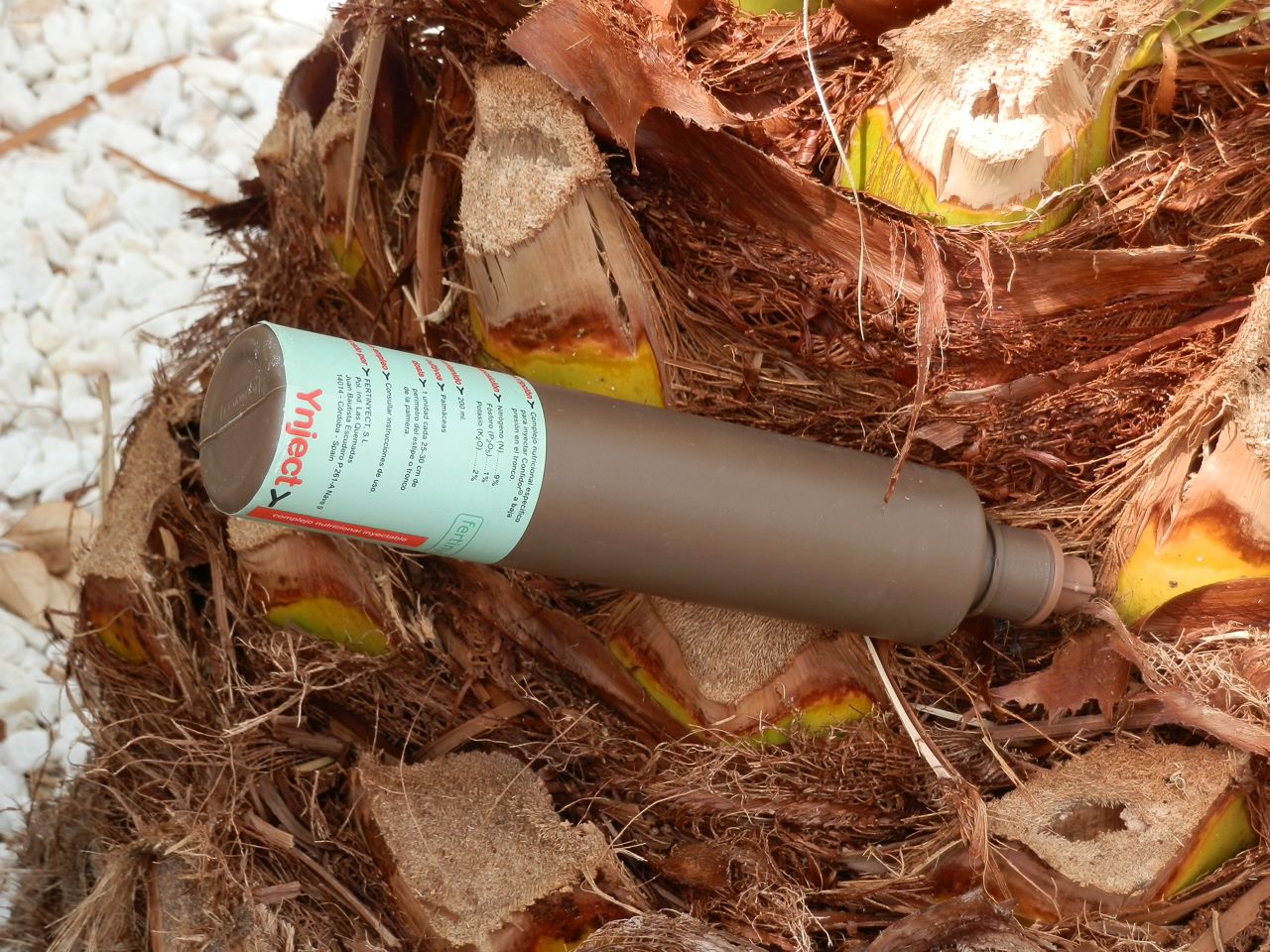
I, too have been spraying the Phoenix palm in our garden, which is next to the garden in which the affected palm was located. As the danger of attack by the beetle now seems more imminent, however, I have resorted to rather more drastic measures. These involvs the injection of a special chemical directly into the base of trunk of the palm. This procedure can be carried out in a DIY fashion, using equipment that can be purchased from Sospalm (and there's a link on their site to a video to show just how to do it), or the La Torre garden centre can come and place a similar system called Ynject in your palm together with a first dose of insecticide (good for three months) for just 25 euro. I chose the latter solution and here you see the insecticide bottle fitted to the injector, which has been inserted into a long hole, drilled into the base of the palm.

Ynject system fitted with insecticide tube

The insecticide drains into the injector and so into the base over the course of three days, after which the tube can be removed, leaving the fitment of the injector inserted in the palm, practically invisible, but ready to be used again for the next tube in three months time. Apparently, this system is highly effective.

If you have one or more Phoenix-type palms (those with long fronds), then you should at least ensure that they are regularly sprayed with an insecticide that is recommended for use against the Picudo Rojo. For more security, the injection-type of application not only offers better protection, it also means that you need only repeat the treatment every three months.

As for Washingtonia-type palms (those with hand-palm-like leaf fronds), these are far less susceptible to  attack by the Picudo Rojo. Note, however, that this does not mean that they are immune to attack, so preventative spraying with a suitable insecticide is still recommended.

Washingtonia type palm

For more information on the Picudo Rojo (Red Palm Weevil), see

Thursday, 26 July 2012

The Dama de Guardamar


To celebrate the 25th anniversary of her discovery, the Dama de Guardamar (also known as the Dama de Cabezo Lucero) has returned to Guardamar from her usual residence in the Archaeological Museum of Alicante (MARQ). She will remain displayed here until 6 October 2012.

The Dama de Guardamar is a sculptured bust of an Iberian lady that was discovered on 22 September 1987 in the archeological site of Cabezo Lucero, which is not very far at all from El Raso.

Unlike her similar counterpart, the Dama de Elche, which was discovered intact, only pieces of the Dama de Guardamar were found, and these showed signs of having been deliberately broken by hammering, as well as scorch marks. Some pieces, however, were quite large, including one of the wheel-like ornaments worn on each side of the head, part of the face, neck and head-dress. In any case, sufficient pieces were found to identify the piece as a bust and to enable its full reconstruction. This took place in the Archaeological Museum of Alicante between October 1987 and June 1988.

The Lady of Guardamar probably dates form between 400 and 370 BC.

The exhibition that has been organised around the Dama de Guardamar can be visited for free in the Casa de Cultura. It is tastefully done, with explanatory notes in Castilian, Valenciano, and English. Sadly, instead of being shown as the Lady of Guardamar, the Dama is indicated as being the Dame of Guardamar, which seems to place her more in the realm of pantomime than patrimony.

Sunday, 5 February 2012

Earthquakes

We were rudely awoken at a quarter to six this morning (a quarter to six, mind you: that's 05:45 and far too early for any living organism to be awoken) by a strange rumbling noise and a brief but very noticeable shaking. Responsible for this unwelcome phenomenon was a small earthquake of magnitude 3.1, whose epicentre was located some 15 kilometres off the coast of Torrevieja, at a depth of about 11 kilometres.
Numerous earthquakes have occurred in the area during the past twelve months, but few have been of sufficient strength to have been felt. Also, they have usually taken place during the daytime, so that their effects are noticed less. The last largish tremor was on 23 March, 2011, but it took place close to midday and, even though it was of the same strength as today's, many people didn't even notice it.
No damage or injury has been reported as a result of today's tremor.
We live in a seismically active area, so tremors and quakes are not at all unusual. Few, however, are as strong as the 1829 earthquake, known as the Torrevieja Quake. This occurred on 21 March, 1829, when numerous towns in the Alicante province were seriously affected, with the most damage being in Almoradí.
Between 1820 and 1830 an unusual amount of seismic activity was registered in the province, especially along the three fault lines of the Bajo Segura (lower Segura): Benijófar, Guardamar del Segura, and Torrevieja.
Between 13 September, 1828 and 21 March, 1829, it is estimated that more than 200 quakes took place. Finally, at a quarter past six in the evening of 21 March, a major quake with a magnitude of 6.6 on the Richter scale, with its epicentre between Benijófar and Torrevieja, caused 389 deaths and 209 injuries, and destroyed more than two thousand homes, with many others badly damaged. The bridges across the river Segura in Almoradí, Benejúzar, Dolores, and Guardamar were all destroyed. Half of the fatalities were in Almoradí, where the roads were narrower than elsewhere and the buildings higher.
In our own Guardamar, 380 houses were completely destroyed, 140 received considerable damage, and 115 suffered fire damage (fortunately, only four people lost their lives and 20 were injured). The medieval town was completely destroyed, so that a new town had to be designed and built. This was done based on a neoclassical plan, having long straight roads with perpendicular intersections and three squares (two small, one large) arranged symmetrically. The new houses were built low and with large yards, in order to minimise the effects of future earthquakes. Stones from the old town were used to build the new. The photo below, dating from 1930, shows the layout of the rebuilt town, with the castle and old town visible in the top right.


(Photo from the book, Guardamar del Segura. Arqueología y Museo available from the Casa de Cultura, Guardamar)

Thursday, 5 January 2012

Roscón de Reyes

Since before Christmas you have probably noticed variously sized, though usually quite large, circular pastries in patisseries and the corresponding sections of supermarkets. These are the so-called roscón de Reyes, which is a traditional cake, baked for consumption on the afternoon of 6 January, the Day of the Three Kings.

Dough is formed into a circle and decorated with pieces of crystallised fruits of various colours, and is also often sliced and filled with cream or confectioner's custard. In addition, a bean and a porcelain figure are hidden in the cake.

As with almost all traditions related to Christmas, the origin of the roscón dates back to earlier pagan traditions and probably to the Saturnalia, the ancient Roman festival in honour of the deity Saturn. At that time, circular cakes made with figs, dates and honey were distributed equally between both plebeians and slaves. Reports indicate that as early as the third century a bean was hidden in the cake and that the person who received the piece containing the bean was named the King of Kings for a predetermined period of time.

It is only since the twentieth century that the cake has been prepared with a filling of cream, or confectioner's custard, or even cabello de ángel (a very sweet pumpkin preserve). A porcelain figurine, usually representing some biblical character, is hidden in the cake, and the tradition of hiding a bean in the cake also remains, though its finder is less fortunate than in earlier times: now they have to pay for the cake, whereas the finder of the figurine is allowed to wear the crown (usually a paper crown is sold with the cake).

Friday, 16 December 2011

Spanish Christmas Carols


There is not really a tradition in Spain for the type of Christmas carols that we know in more northerly parts of Europe. Some of those carols are known here and have their own Spanish versions, such as Venid Fieles (Adeste Fiedeles), Al Mundo Paz (Joy To The World) and Noche de Paz (Silent Night), but the real Christmas singing tradition here is based on a large group of songs called Villancicos.

The villancico was a popular form of poetry and singing in Spain, Portugal, and their colonies, for several centuries, starting in the second half of the 15th and continuing into the 18th. The style declined in popularity in more recent times and the term "villancico" gradually came to represent little more than a Christmas carol.

Despite, this degeneration, the medieval musical influence can still be gleaned in the villancicos that remain popular around the Christmas period. This is aided by the often medieval flavour of the music and its instrumentation, which still often consists of little more than a simple drum, a zambomba (a friction drum, or, in Dutch, a rommelpot), and some tambourines (panderetas in Spanish). In the Comunidad Valenciana, a dulzaina might also be used and in Andalucía, the villancico has become particularly popular performed in flamenco style, accompanied by guitars, castanets, hand-clpping and the cajón.

Villancicos are most often sung by groups of children (who, strangely enough, seem to have little musical ability) and this adds to the naivety of the whole. A glorious exception to this rule is provided by the flamenco performers of villancicos, who transform the simple songs into superbly exciting numbers: look out for a group called Raya Real in this respect.

So why not scrap the traditional carols this year and instead go for a more Spanish form of Christmas entertainment? You can find plenty of sites online where you can listen to villancicos, performed both well and badly, and lots of CDs are available in the shops, too, though these are of equally diverse quality.

Navidad Digital is a good place to start. Not only does the site offer many, many villancicos, it also allows you to hear carols in French, German, Italian, Latin and English. (In addition, you will find information about Belenes, recipes for traditional end-of-year fare, and hundreds of photos.)

And here is a short list of some of the more popular and traditional villancicos:

  • La Marimorena
  • Campana Sobre Campana
  • El Burrito Dabanero
  • Ya Viene La Vieja
  • Los Peces En El Rio
  • Arre Borriquito (Arre Burro Arre)
  • Alegría Alegría
  • Fum Fum Fum
  • Rin, Rin
  • El Chiquirritín

¡Felices fiestas!