Showing posts with label pests. Show all posts

Monday, 10 September 2012

Picudo Rojo, the Red Palm Weevil, strikes!

A year ago, I wrote an entry about the Red Palm Weevil, the Picudo Rojo. Things have certainly not improved since then. Indeed, the Picudo Rojo has created its first victim (that I am aware of) in our community.

 A Phoenix palm in Calle San Bruno suddenly showed signs of distress and investigation proved that it had been attacked by the Picudo Rojo. Its leaves had fallen more open than normal and some of the central leaves could be easily pulled out of the stem, because the larvae of the beetle had eaten away the connecting tissue.

Affected Phoenix palm


Base of leaf stem, eaten by larvae

The palm in question had been regularly sprayed with insecticide, but this was clearly insufficiently effective to prevent the devastating attack and the loss of the palm.

The palm has had to be removed and destroyed. When it was cut, several beetles were found in the base, as well as many larvae, some very small, others very large. Here are some of these attractive individuals…

Larvae of Picudo Rojo

I, too have been spraying the Phoenix palm in our garden, which is next to the garden in which the affected palm was located. As the danger of attack by the beetle now seems more imminent, however, I have resorted to rather more drastic measures. These involvs the injection of a special chemical directly into the base of trunk of the palm. This procedure can be carried out in a DIY fashion, using equipment that can be purchased from Sospalm (and there's a link on their site to a video to show just how to do it), or the La Torre garden centre can come and place a similar system called Ynject in your palm together with a first dose of insecticide (good for three months) for just 25 euro. I chose the latter solution and here you see the insecticide bottle fitted to the injector, which has been inserted into a long hole, drilled into the base of the palm.
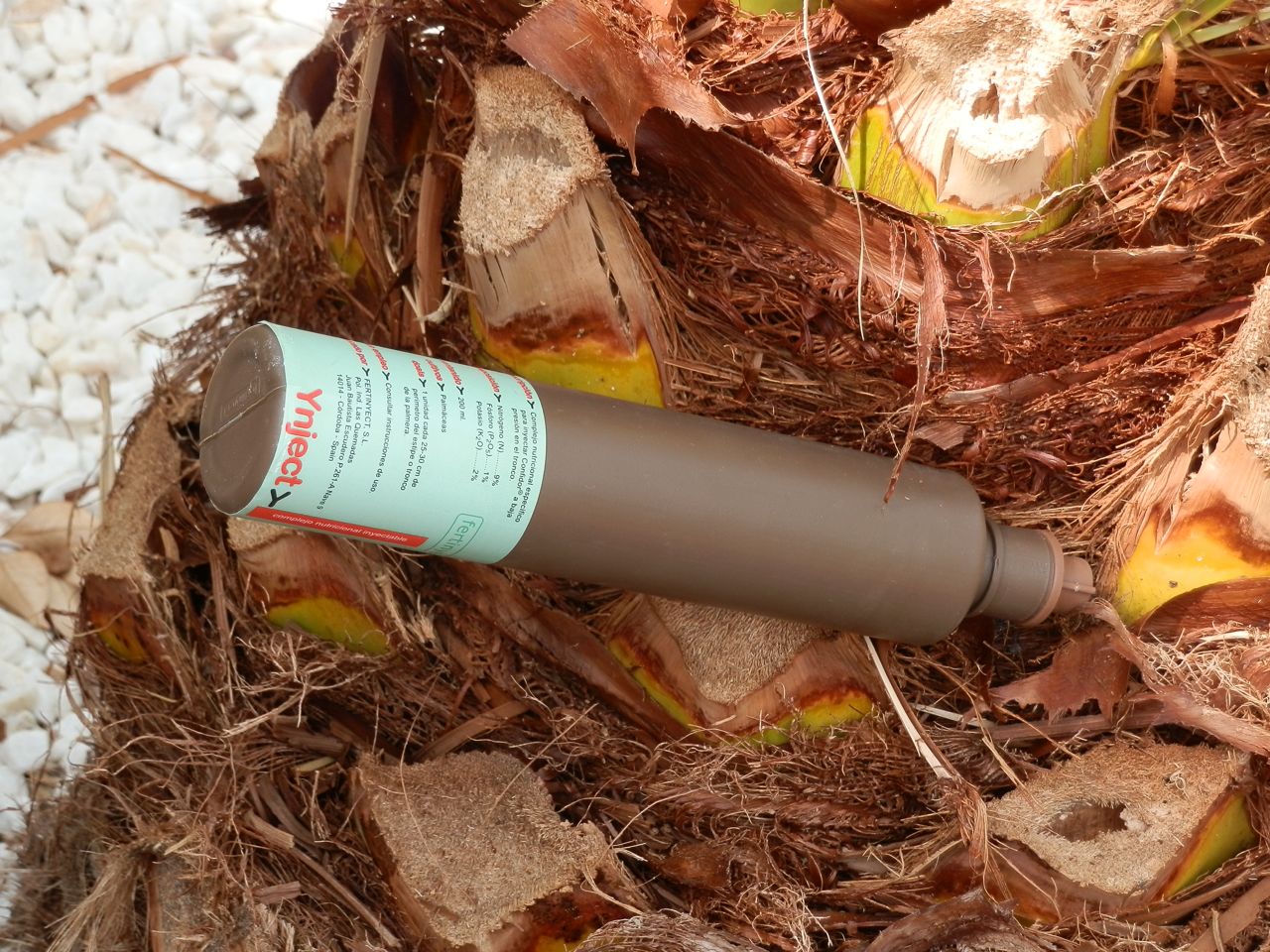
Ynject system fitted with insecticide tube

The insecticide drains into the injector and so into the base over the course of three days, after which the tube can be removed, leaving the fitment of the injector inserted in the palm, practically invisible, but ready to be used again for the next tube in three months time. Apparently, this system is highly effective.

If you have one or more Phoenix-type palms (those with long fronds), then you should at least ensure that they are regularly sprayed with an insecticide that is recommended for use against the Picudo Rojo. For more security, the injection-type of application not only offers better protection, it also means that you need only repeat the treatment every three months.

As for Washingtonia-type palms (those with hand-palm-like leaf fronds), these are far less susceptible to  attack by the Picudo Rojo. Note, however, that this does not mean that they are immune to attack, so preventative spraying with a suitable insecticide is still recommended.

Washingtonia type palm

For more information on the Picudo Rojo (Red Palm Weevil), see

Monday, 7 November 2011

Stray Cats

I dislike cats at the best of times. Stray cats are even worse. They are a plague on society and, in my opinion, should be eliminated.

They should certainly not be fed by silly people who look upon them as poor, helpless creatures (and usually "God's creatures" at that). They are wild animals that carry diseases, worms, and other unpleasantness. The argument that they keep down vermin, such as mice and rats, is simply laughable: a cat has very little chance against a rat and if a stray cat knows it can get its food from that woman down the road, it is not going to bother to go out hunting. Rats and Mice? What about the lizards and birds that these obnoxious pests eat? The cats destroy these beneficial creatures in huge numbers (or they would, if they were not fed so much by people who should know better).

The photo shows the result of the latest stray cat damage in our garden. Apart from leaving their smelly faeces and urine around the place, the cats seem to enjoy digging in newly planted soil. They are pests and need to be destroyed. I, at least, am able to replace the soil and, when necessary, even replant disturbed or completely uprooted plants. People who do not live here permanently are unable to take such actions to correct the damage caused by these four-legged pests. There, is, of course, little that can be done but hope as far as urine burns on plants are concerned.

I call on you all to please stop feeding the stray cats.

(Please note that this is a personal opinion)

David Neale

Wednesday, 28 September 2011

Picudo Rojo, the Red Palm Weevil

On several occasions recently, I have noticed red palm weevils (Rhynchophorus ferrugineus) flying across the garden. I have come across one or two dead ones on the tiles around the house, too, and just a couple of days ago I was able to capture a live one. I took it to La Torre garden centre to confirm that it was, indeed, a Picudo Rojo. This being the case, I bought some insecticide suitable for dealing with possible attacks by such creatures in young palms.

The insecticide that was recommended is called Insecticida Llanero, sold in a bottle of 100ml.This is different to that which I have been using up until now, which was made by Bayer and sold as a set of four individual doses of 2ml (Insecticida polivalente, with the specific announcement, "Protege las palmeras").

I have already been spraying the one young palm in our garden every few weeks for several months, as I was aware of the dangers of the Picudo Rojo, so hopefully our palm is relatively safe. If you are worried about your own palm(s)—and you should be, for the Picudo Rojo is a huge threat in this area—get some preventative spray, such as one of those mentioned above, and use it on each palm, thoroughly soaking the trunk, leaves and centre of the plant every ten days or so.

For more information (in English) on the Picudo Rojo, see this page in the Gardening in Spain website. The information dates from mid-2009, but is still relevant, though now it is thought better to bury infected palms at a depth of at least two metres, rather than burning them.

An interesting film, showing the unsightly, monstrous larvae of the Picudo Rojo can be seen here.


David Neale