This week sees the run-up to the grand processions of Moros y Cristianos, which will be held on Saturday, 26 July and Sunday, 27 July.
Various events will take place throughout the week, a full list of which can be found at this address. If you have small children, you might wish to avoid the centre of Guardamar during the guerillas on 23 and 24 July: these involve members of the various Moors and Christians groups going through the streets firing what can best be described as blunderbusses, in what seems to be an attempt to make as much noise and smoke as possible.
The two big processions, however, form the magnificent culmination to the week's activities, with lines of magnificently adorned group members march down the Avda. del País Valencià and on along the Calle Major (the whole length of the main street in Guardamar), starting from the end nearer to El Raso. Most lines are preceded by an animator, whose job is to extract applause from the onlookers, and groups of several lines are separated from one another by music corps, the occasional float, and sometimes dancers or other diversions.
The whole thing lasts a couple of hours or more and starts each evening at eight-thirty. Take something to sit on and plenty of water if you want to stay for the duration. Each evening offers something different: on Saturday the Christians lead the parade, followed by the Moors, while on Sunday the Moors have the honour of going first. Most groups wear different costumes each night, so seeing the parade twice is not a bad thing.
Here are a few photos from previous years' parades:
Sunday, 20 July 2014
Flavours of Spain
When you come to live in another country, you really do not want to limit yourself to the food you already know from your country of origin. Elise and I come from Belgium (well, I come from Wales originally, but lived in Belgium for 35 years, so…). Belgium is a small country with a fine culinary tradition, offering plenty of variety, from sweet chocolate pralines to delightfully common stoofvlees met frieten, to more select plates that tempt even the most demanding of gourmets.
Now that we live in Spain, however, we like to try the local dishes, but this is not as easy at it sounds. Spain is a huge country and it isn't feasible for us to pop up to Asturias or Galicia, or across to Extremadura for an evening meal that includes the local specialities. We were therefore delighted to find a service offered by a company called GoodelitBox, which is advertised as offering gastronomic tourism.
The idea is that each month you receive a box of several specialities from a particular region of Spain, together with a booklet that explains what each product is and how it might be prepared. Each month a different region is selected, so that over the course of several months you can start to get an idea of the range of products available in the different parts of Spain. Great idea. Each box costs about 50 euro, but this can be reduced by ordering more than one box at a time. To start with, we have ordered three boxes, one each per month, which saves us about 10 euro. The price includes delivery.
Our first box arrived a few days ago, containing products from the region in which we live, Alicante. As you can see from the picture above, the box itself is pretty smart, being of hard cardboard, covered with a dark blue paper, which is embossed with a logo that incorporates a map of Spain.
Lifting the lid revealed that the products were well packed in straw. On top of the straw lay a GoodltBox business card, the booklet about the products, a packet of mojama de atún (best described as a tuna ham), and a packet of date-and-walnut cake:
We shall start on this lot (the pomegranate jam and the turron spread shouldn't last very long!) and look forward to receiving our box of delights from Asturias next month.
If you'd like more information about GoodliteBox, visit their site here (you'll find a section in English, too). Note that they also provide a blog, where recipes can also be found (this part only in Castellano).
Now that we live in Spain, however, we like to try the local dishes, but this is not as easy at it sounds. Spain is a huge country and it isn't feasible for us to pop up to Asturias or Galicia, or across to Extremadura for an evening meal that includes the local specialities. We were therefore delighted to find a service offered by a company called GoodelitBox, which is advertised as offering gastronomic tourism.
The idea is that each month you receive a box of several specialities from a particular region of Spain, together with a booklet that explains what each product is and how it might be prepared. Each month a different region is selected, so that over the course of several months you can start to get an idea of the range of products available in the different parts of Spain. Great idea. Each box costs about 50 euro, but this can be reduced by ordering more than one box at a time. To start with, we have ordered three boxes, one each per month, which saves us about 10 euro. The price includes delivery.
Our first box arrived a few days ago, containing products from the region in which we live, Alicante. As you can see from the picture above, the box itself is pretty smart, being of hard cardboard, covered with a dark blue paper, which is embossed with a logo that incorporates a map of Spain.
Lifting the lid revealed that the products were well packed in straw. On top of the straw lay a GoodltBox business card, the booklet about the products, a packet of mojama de atún (best described as a tuna ham), and a packet of date-and-walnut cake:
Removing the layer of straw revealed the following items: a bottle of Vino Cap d'Or Moscatel Mistela D.O.P. (Muscatel wine with l'appellation d'origine contrôlée); a jar of pericana (a sauce made of dried tomatoes, pine nuts, and cod); a jar of spreadso de alcachofa natural y aceituna negra (a mixture of artichokes and black olives, used in all sorts of preparations); a jar of pomegranate jam (very difficult to find); a jar of turrodella (a turrón spread, also difficult to find); a bottle of 100% ecological virgin extra olive oil. Here you can see these products, still in the box:
A pretty good first box, I think you'll agree. Here's you can see all the important contents:
We shall start on this lot (the pomegranate jam and the turron spread shouldn't last very long!) and look forward to receiving our box of delights from Asturias next month.
If you'd like more information about GoodliteBox, visit their site here (you'll find a section in English, too). Note that they also provide a blog, where recipes can also be found (this part only in Castellano).
Tuesday, 5 November 2013
The Toros de Guisando
There seems to be a very strange ambiguous attitude towards bulls here in Spain. People purport to have great respect for the animals and then promptly turn round to organise nonsensically cruel "traditions" such as bullfighting, or chasing the bulls through narrow streets, or making them jump off harbour walls, or running after them with spears on horseback, or tying flaming torches to their horns, or…
Well, you get the picture. For a supposedly civilised country still to allow such cruelty is just crazy. And the excuse that it is all done in the name of tradition is too pathetic to be taken seriously.
Anyway, there are bulls in Spain other than those poor creatures who have to undergo such senseless treatment. Sadly, few people, either in or out of Spain, seem to know about them, so here's a piece to whet your appetite.
Elise and I recently travelled to Belgium by car. Elise had decided that it would be a good idea to visit Toledo on the way, so we decided to make a trip of it and to also visit Avila and Segovia. Well, on the road between Toledo and Avila I noticed a small sign pointing to the Toros de Guisando. That rang a bell; somehow I knew something about these bulls, but I had no idea from where. Anyway, it was a quick left hand down a bit in order to turn onto the direction indicated. Within a couple of kilometres we arrived at the location of the bulls. In fact, we almost drove past the place, as it is so poorly indicated.
There is just a small parking area at the side of the road with a couple of very small signs, hidden by the branches of some large trees, to point out to the weary traveller that this is the place.
Behind a fairly substantial wall, hidden from view of passing traffic and with just a single small entrance gate, is an open area of ground in which stand four magnificent stone bulls.
The bulls are over two thousand years old and were once spread over the surrounding fields. Nobody knows their purpose: magical, religious, fertility symbols…? Perhaps there were more such bulls in the area, certainly the types of rocks that lie in the fields offer plenty of suitable raw material. In any case, these four were brought to their current location probably in Roman times, in about the third century.
Each sculpture is about two metres long and perhaps one metre-thirty high. The carving is naive, but very beautiful and the bulls present a very strong impression. They each seem to have its own character. They are, of course, well weathered, but remains of exceptional detail can still be seen, most notably in the skin folds on the neck of one of them.
Another bull carries a Latin inscription that dates from the time that the Romans moved them.
Well, you get the picture. For a supposedly civilised country still to allow such cruelty is just crazy. And the excuse that it is all done in the name of tradition is too pathetic to be taken seriously.
Anyway, there are bulls in Spain other than those poor creatures who have to undergo such senseless treatment. Sadly, few people, either in or out of Spain, seem to know about them, so here's a piece to whet your appetite.
Elise and I recently travelled to Belgium by car. Elise had decided that it would be a good idea to visit Toledo on the way, so we decided to make a trip of it and to also visit Avila and Segovia. Well, on the road between Toledo and Avila I noticed a small sign pointing to the Toros de Guisando. That rang a bell; somehow I knew something about these bulls, but I had no idea from where. Anyway, it was a quick left hand down a bit in order to turn onto the direction indicated. Within a couple of kilometres we arrived at the location of the bulls. In fact, we almost drove past the place, as it is so poorly indicated.
There is just a small parking area at the side of the road with a couple of very small signs, hidden by the branches of some large trees, to point out to the weary traveller that this is the place.
Behind a fairly substantial wall, hidden from view of passing traffic and with just a single small entrance gate, is an open area of ground in which stand four magnificent stone bulls.
The bulls are over two thousand years old and were once spread over the surrounding fields. Nobody knows their purpose: magical, religious, fertility symbols…? Perhaps there were more such bulls in the area, certainly the types of rocks that lie in the fields offer plenty of suitable raw material. In any case, these four were brought to their current location probably in Roman times, in about the third century.
Each sculpture is about two metres long and perhaps one metre-thirty high. The carving is naive, but very beautiful and the bulls present a very strong impression. They each seem to have its own character. They are, of course, well weathered, but remains of exceptional detail can still be seen, most notably in the skin folds on the neck of one of them.
![]() |
| Carving details still visible |
![]() |
| Latin inscription on side of bull |
Although the site of the bulls seems to be little known nowadays, it must have been held in some esteem in times gone by, for it was here that Enrique IV proclaimed his sister, Isabella the Catholic, as his rightful heir to the Kingdom of Castilla in 1468.
![]() |
| A small information panel provides some history |
Location:
El Tiemblo, Ávila, Spain
Wednesday, 21 August 2013
Recipe: Ensalada Murciana
![]() |
| Serving suggestiion |
One of the really pleasant aspects of living in another country, is being able to learn new foodstuffs or different ways to use those we are already used to. The area of the Mediterranean is known for its richer and more intense flavours than those we are used to in the north of Europe. The meat is excellent, the fish is abundant and fresh, and the fruits and vegetables are exceptional.
I enjoy cooking and I enjoy food. I like trying new ways of preparing meals. It’s all very well to eat something different in a restaurant, but here I hope to be able to persuade you to prepare something with a Mediterranean and Spanish flavour yourself. Even my husband likes this recipe, so it can’t be that bad.
Ensalada Murciana is a simple local salad. Note that, instead of fresh tomatoes, tinned tomatoes can be used (the Spanish sort, not the Italian) and that this is, indeed, more authentic.
Ingredients for two people:
- 1 hard boiled egg
- 3 red peppers (eg Freshona Gourmet Pepper, 650 g. from Lidl)
- 3 normal-sized tomatoes (or one tin, drained)
- 1 medium onion
- 220 g. tin of tuna in oil
- 12 or more black olives
- olive oil, white wine vinegar, salt and pepper
Method: cut peppers into strips; slice tomatoes; dice onion; drain tuna; chop egg. Place everything on a serving-dish: start with the tomatoes, on top of them the peppers and onions; crumble the tuna over the whole and then sprinkle the egg on top. Season with salt and pepper, vinegar and olive oil. Scatter the olives evenly over the surface. Cover and leave to rest for about an hour, after which time the enslada murciana is ready to be served, perhaps with bread and allioli.
This dish comes in as many varieties as places that serve it: cod is sometimes used instead of tuna, for example. It is normally served as a primer plato, or as a tapa.
Elise De Leeuw
Sunday, 7 July 2013
Moors and Christians 2013
Prior to the actual Fiestas de Moros y Cristianos, which takes place from 19 to 28 July this year, there will be a Medieval Market from 15 to 17 July, held in the Calle Castillo, behind the church. The market will be officially opened at 11:30 on Monday 15 July.As for the Fiestas de Moros y Cristianos themselves, what follows is only a brief outline of the events planned. For a full calendar of events in English, visit this page or pick one of the free printed calendars that can be found all around Guardamar.
The run-up to the last two days can be confusing to people from outside Guardamar, especially with the street battles and peculiar mixture of religion. However, there are a couple of concerts you might enjoy and there is no doubt at all that you will more than impressed by the parades of the last two days. To give you an idea of the costumes, you might like to have a look at my photos from 2011 (and from there you can follow a link to see other years, too).
Friday, 19 July
Starting at 21.30, pomp and circumstance as the Queen of the Fiestas together with others walk from the Plaza Labradores along the Calle Mayor to end up in the Plaza de la Constitución.
22.00 Opening speech by Inmaculada Cases Gómez, of the Hospital Vega Baja.
22.30 Presentation of standards (flags)
23.00 Coronation of the Queen of the Fiestas, including a light, water and fire spectacular.
Saturday, 20 July
22.00 Fancy Dress Parade and competition, starting at the corner of the Calle Mayor and the Calle Norte and passing along the Avenida País Valenciano, to finish in the Plaza Jaume II.
Sunday, 21 July
20.30 Music Concert in the Parque Reina Sofia.
Monday, 22 July
20.30 Choral Concert, including the Aromas de Guardamar choir (presumably in the Parque Reina Sofía, though you should check on this first).
Wednesday, 24 July
20.00 First street battle. Lots of noise. Followed at 21.00 by the entry into the castle (on the Plaza de la Constitución, presumably) by the Christians and its subsequent loss to the Moors.
Thursday, 25 July
11.30 Parade with the Music Society of Guardamar accompanying the Queen of the Fiestas and others through numerous streets, starting in Calle Colón and passing through Calles Gratitud, San José, Inginiero Mira, Ausias March, Las Viñas, Luis Rivera, Mediodía, Vicente Ramos, and Ingeniero Mira again to end in the Plaza de la Constisución.
21.00 Another procession, but more sobre,, passing along C/ Ingeniero Mira, Plaza de Abastos, C/ San Emigdio, C/ Valencia, C/ Mayor, Avda. País Valenciano, C/ Medio día, C/ Vicente Ramos yand ending at the church.
01.00 Firework display on the Playa Roqueta.
Friday, 26 July
20.00 Second street battle. Lots of noise again. This time the Moors enter the castle and the Christians come along to take it from them.
Saturday, 27 July
(This is really what it's all about)
20.30 Moors and Christians Parade. First the Moors, then the Christians, interspersed with marching bands. They leave from the corner of Calle Lepanto and Avenida País Valenciano, marching line-abreast along Avenida País Valenciano, Calle Mayor, and ending at the the crossing of Calle Mayor with Calle Norte.
Sunday, 28 July
19.00 Marching bands parade, starting at the crossing of Calle Mayor with Calle Norte and following the reverse route of the Moors and Christians Parade.
20.00 Moors and Christians Parade. This time the Christians lead the parade, followed by the Moors. Don't think this is a mere duplicate of the previous day's parade: most comparsas wear different costumes on each day.
01.00 Fireworks Display at the castle (the real castle this time!).
Tuesday, 2 July 2013
Time to Learn Some Spanish
It is very easy to make excuses about being too old to learn (rubbish), or that the Spanish speak too fast (it's a foreign language and they always sounds fast in the beginning), or some other reason to try to opt out of what you would probably consider to be an obligation for visitors to your own country: to learn the language of your country.
All nonsense, for you are perfectly capable of learning at least some basic Spanish and once you have that, you can continue to more adventurous conversations.
The thing is, you are not going to learn Spanish by reading a teach-yourself book or by going to evening classes. That's not how you learned your own language, so why do you think it would be a good way to learn Spanish? Okay, if you don't live here permanently, you might use these approaches to get some sort of start under your belt, though don't expect much more than that, for such methods will also require that you have a knowledge of grammar (you do know what the subjunctive voice is, don't you?).
No, the best way to learn any foreign language is to learn it in the same way you learned your own language: use it! Take every opportunity you have to stumble out a few words and to listen carefully to the native speakers. Don't worry about making mistakes: you make plenty of them in your own language (everyone does), so why worry about them when you are learning another language?
And don't just take my word for it. Here are some thought from an Irish polyglot. And a lot of sense he makes, too!
If you're still not utterly convinced that you can go out into the big wide world and actually speak Spanish with Spaniards, there's a great free course available that will give you an excellent start. No, it doesn't worry you with any grammar or tests or any other scholastic nonsense. Instead, it encourages you to make active use of the language right from the beginning, so that you get used to hearing others speaking Spanish, both native speakers and English speakers. You also yourself speaking Spanish and this is important, because in the beginning it's strange to hear yourself speaking something other than your own language. Thus you pick up the language in a natural way. The course is called Say Something In Spanish and if you give it a go I'm sure you will be surprised at how much Spanish you pick up in just the first lesson.
(And if you're really in for a challenge, there's a similar course called Say Something In Welsh).
Thursday, 13 June 2013
A Couple of Shakes
We live in a reasonably active area, at least as far as seismic activity is concerned. And earthquakes have no respect for a good night's rest, so at about twenty past five local time this morning, we were shaken awake by quite a good rumble. The epicentre of this nocturnal motion (if you'll pardon the expression) was literally just up the road form us, as can be seen in the map to the left (click on it for a larger image), provided by the Instituto Geográfico Nacional. The maximum magnitude was 2.8 and here in El Raso it was probably about 2.7. Not bad for a night's work.
As if that wasn't enough excitement for the day, this afternoon, at about twenty-five past three, there was a nasty little blip, which felt as if it was just below us. This time the epicentre was first reported by the Instituto to have been just off the coast, next to the lake at the bottom of El Raso, but that information was later corrected, to place the epicentre to the north-west of Guardamar, as can be seen in the following map:
This rumble had a magnitude of 3.2.
Who knows? There might be more to come, so batten down the hatches; make everything ship-shape and Bristol-fashion.
As if that wasn't enough excitement for the day, this afternoon, at about twenty-five past three, there was a nasty little blip, which felt as if it was just below us. This time the epicentre was first reported by the Instituto to have been just off the coast, next to the lake at the bottom of El Raso, but that information was later corrected, to place the epicentre to the north-west of Guardamar, as can be seen in the following map:
This rumble had a magnitude of 3.2.
Who knows? There might be more to come, so batten down the hatches; make everything ship-shape and Bristol-fashion.
Friday, 7 June 2013
A special visitor
![]() |
| Megascolia maculata flavifrons (female) |
And it really does live up to its "mammoth" name, for it is at least 5cm long. In fact, I have spotted two individuals, the larger one at 5cm or more and a smaller one that is perhaps 4.5cm long. Both of them are impressive creatures.
Both of them are also females. The body of the female mammoth wasp is black with large yellow markings. She has strong wings, tinged with amber, resembling the skin of an onion, showing crimson in the variegated light. Her legs are coarse, with a knotted appearance and are very hairy. She has a huge body and a powerful head, which is well protected by a hard skull. Her flight is quite low and is surprisingly quiet for such a large insect. The male mommoth wasp, which I have not yet seen, is less colourful and of finer frame.
The mammoth wasp does not attack humans (no European wasps do, except out of self-defence, so stop waving your arms about). Instead, it hunts out the larvae of the rhinoceros beetle (Oryctes nasicornis), which it paralyses with its sting in order to lay a single egg in the beetle's body. When it emerges, the larva of Megascolia then devours that of the Oryctes.
And here's a little video (the quality is far better than the preview image).
You can see more unusual visitors to our garden here.
David Neale
Tuesday, 4 June 2013
Jai-Pe Services
A new service has just been inaugurated in the Euroterra Commercial Centre of El Raso. The business is called Jai-Pe Services and has been the subject of numerous rumours.
No, it is not a new venture started by the owners of the Indian restaurant next door to the premises.
No, it is not a Gamma supermarket outlet.
No, it is not a hairdresser.
No…
Well, you get the idea.
What it is, is rather difficult to describe in just a few words. First, a bit of history. Some time ago, before the urbanisation El Raso was built, a young couple in Guardamar decided to branch out on their own, offering cleaning services to local businesses and communities of owners. Pedro and Maribel decided to call their new company Jai-Pe, a strange-sounding name, perhaps, but all becomes clear when you learn that they had a single apple of their eye; the name of the little lad (for little he was at the time) was Jairo.
Got it? Jai (from Jairo) and Pe (from Pedro), forming the exotic-sounding Jai-Pe.
Well, the cleaning business in Guardamar flourished and Jai-Pe extended its services to include individual properties and all aspects of cleaning: windows, tiles, terraces, garages… they'll come along and do an excellent job, as several users of their services on El Raso and within our own community will testify.
Maribel, knowing a good thing when she sees it (well, she married Pedro, didn't she?) recently decided that there might be a gap in the market and thought El Raso would be a good place to test her theory. Pedro saw something in it, too, so the couple leased one of the units in the commercial centre and have now set it up as a sort of information and contact centre.
Not only can you go to the establishment to buy cleaning products of all sorts, but Jai-Pe Services also offers a collaboration service, so that, should you need to find, say, a bricklayer, or a plumber, or a gardener, or a locksmith, or a carpenter, or a metalworker, or anything else to do with the maintenance of your property, you need only visit Jai-Pe Services and their staff will help you find just who you need. They'll even find you translators and interpreters if you wish.
Of course, you can also arrange to have your property cleaned, either on a regular basis, or just when you wish, and Jai-Pe Services will also act as key-holder for you when you are not here, but still need your property to be accessible.
Jairo (the apple of his parents' eye, remember?) is now a young man, recently graduated from higher education, and he has taken on the responsibility of running the new Jai-Pe Services office in El Raso. He has a small staff to help him.
You can find out more about Jai-Pe Services at their website, which will soon also be available in English.
No, it is not a new venture started by the owners of the Indian restaurant next door to the premises.
No, it is not a Gamma supermarket outlet.
No, it is not a hairdresser.
No…
Well, you get the idea.
What it is, is rather difficult to describe in just a few words. First, a bit of history. Some time ago, before the urbanisation El Raso was built, a young couple in Guardamar decided to branch out on their own, offering cleaning services to local businesses and communities of owners. Pedro and Maribel decided to call their new company Jai-Pe, a strange-sounding name, perhaps, but all becomes clear when you learn that they had a single apple of their eye; the name of the little lad (for little he was at the time) was Jairo.
Got it? Jai (from Jairo) and Pe (from Pedro), forming the exotic-sounding Jai-Pe.
Well, the cleaning business in Guardamar flourished and Jai-Pe extended its services to include individual properties and all aspects of cleaning: windows, tiles, terraces, garages… they'll come along and do an excellent job, as several users of their services on El Raso and within our own community will testify.
Maribel, knowing a good thing when she sees it (well, she married Pedro, didn't she?) recently decided that there might be a gap in the market and thought El Raso would be a good place to test her theory. Pedro saw something in it, too, so the couple leased one of the units in the commercial centre and have now set it up as a sort of information and contact centre.
Not only can you go to the establishment to buy cleaning products of all sorts, but Jai-Pe Services also offers a collaboration service, so that, should you need to find, say, a bricklayer, or a plumber, or a gardener, or a locksmith, or a carpenter, or a metalworker, or anything else to do with the maintenance of your property, you need only visit Jai-Pe Services and their staff will help you find just who you need. They'll even find you translators and interpreters if you wish.
Of course, you can also arrange to have your property cleaned, either on a regular basis, or just when you wish, and Jai-Pe Services will also act as key-holder for you when you are not here, but still need your property to be accessible.
Jairo (the apple of his parents' eye, remember?) is now a young man, recently graduated from higher education, and he has taken on the responsibility of running the new Jai-Pe Services office in El Raso. He has a small staff to help him.
You can find out more about Jai-Pe Services at their website, which will soon also be available in English.
David Neale
Wednesday, 10 October 2012
Our trip to the Alcalá del Júcar Cave
![]() |
| Houses built into the mountainside, and the castle |
On Sunday 30th September last, John and I with a few friends went on a coach outing to see the Alcalá del Júcar Cave.
On our way we stopped for coffee and a walk around the charming historical town of Almansa.
We then drove on to the fascinating cave village of Alcalá del Júcar. This is a beautiful little village, standing on the banks of the river Jucar and featuring cave houses, a castle, and a quaint market.
![]() |
| Photo courtesy of Juan Manuel Monleón Antón (WikiPedia) |
The trip included a meal at a very Spanish restaurant on the top of the mountain. The restaurant was owned by the Mayor who also seemed to own most of the rest of the village! The food was excellent and included wine and water. The scenery was stunning as you looked down into the village below with the homes going into the mountain.
![]() |
| Looking down into village from mountain-top restaurant |
The river Júcar runs through this village and has a small beach, which is man-made. The market has a few stalls for you to browse around. There are various places for you to have a meal or a drink. We walked up a number of steps to a bar which was built into the mountain.
The coach left us about half way down the mountain, from where we then had to walk about a quarter of a mile continuing down into the village, until we eventually arrived at what looked like the front of a house. We had to pay 3 euro entrance fee and went down over one hundred steps into a very narrow passage. There were gaps every so often in the walls which had pieces of old farming equipment and old items of furniture on display. At the end of this walk we arrived at an area where there was a bar for you to obtain a drink, using the ticket given to you when you paid your 3 euro entry. This area had tables and chairs for you to sit and enjoy the views from the various windows and a large area which we believe was used for discos.
We then walked back to where the coach had originally left us in the village and continued our journey home.
The trip took us about two and half hours to get there, so it is quite a way to visit. But if you have the time and enjoy seeing different and unusual places then it is well worth a visit.
This is a superb day out with lots of places to wander around and see all the different types of buildings. The cost is about 28 euro each with the company David’s Coachtrips.
We certainly enjoyed the day and hope you will too.
Wendy & John Laker
Here are some more photos from John and Wendy:
![]() |
| Spot the ostrich |
For more information about Alcalá del Júcar, visit this WikiPedia page.
Saturday, 22 September 2012
Lady of Elche (La Dama de Elche)
In Belgium we say that there is no such thing as a stupid question, only a stupid answer.When I was at school (yes, I know, a very long time ago…), I had a very wise geography master who took that train of thought a little further: he told us never to be afraid to ask questions and that if one person did not know something, then at least five other people in the class would want to ask the same question. (He was the same master who would not allow us to take notes during his classes, other than on the concrete blocks of our minds, as he put it. He was quite correct in both matters: note-taking is counter-productive and if you do not know about something, there are plenty of others in the same position.)
I was talking to one of our community members recently and was surprised that she had never heard of La Dama de Elche (the Lady of Elche). So, asking the question, "Who is the Dama de Elche?" and following the principles above, we see that
a. it is not a stupid question;
and
b. there must be quite a few other people in our community who know little or nothing about La Dama de Elche.
So, who is she?
Well "she" is really an "it," being a stone bust that was discovered by pure chance in 1897 on a small rise near Elche known as Alcudia (from the Arab word meaning a mound, or small hill). If you drive to Elche using the road though Benijófar, you pass by Alcudia a couple of kilometres before reaching Elche.
It is believed that the Dama de Elche is an Iberian sculpture, dating from the 4th century BC. Who she is, or what she represents is not known with any degree of certainty. Some suggest she represents the Carthaginian goddess Tanit, others that she is, in fact, an urn for storing the ashes of a cremation (a large aperture at the back might indicate this), and there have even been claims that she is a forgery, though these have been adequately dismissed.
What is known, is that she was once painted with lifelike colours and some remnants of these colours can be seen even with the naked eye.
La Dama de Elche was taken to France shortly after her discovery, but was returned to Spain in 1941. Since then she has been located in Madrid. However, between May and November 2006 the Dama was placed on temporary display in Elche and many people took the opportunity to admire her, often forming long queues to be able to do so.
She is a truly beautiful piece of sculpture, far more beautiful than any of the photos of her, and infinitely more so that the multiplicity of reproductions that exist in a whole range of sizes. Several "damas" have been found in Spain: the Dama de Baza, the Gran Dama Oferente, and our own Dama de Guardamar, of course, but none match the beauty of the Dama de Elche.
Here are some photos that I took when the Dama was on display in Elche in the Museo Arqueológico y de Historia (close to the park and well worth a visit). You usually only see her from the front, so I have included one from the back, too, showing the aperture referred to above. The quality of the photos is not wonderful, I'm afraid: the bust was enclosed in a thick glass case in a relatively dark room and I did not have a suitable tripod.

The area where the Dama was found has since become a major archaeological site and offers an interesting place to visit very close by, being no mire than a twenty-minute drive. Go through Benijófar and follow the signs to Elche. Shortly before reaching Elche, on the road of the many roundabouts) you will see signs to the right for Alcudia (if you miss the first lot, don't panic, there's another turning a bit further on). You can find more information, including videos and other documentation here.
Wednesday, 19 September 2012
Waste of time!
At the end of the recent AGM, I took the opportunity to once again remind those present about the existence of this very blog. I heard at least one of those present muttering that it was, "A waste of time."
Well, that person might well be right. I might indeed be wasting my time writing these little articles every now and then and publishing them in this blog. I probably wasted my time a few years ago, when I worked on our brief, but now defunct, community newsletter.
However, I think that I was only wasting my own time then and I think that also applies now. Well, okay, there were a couple of minutes at the end of the AGM when I might have wasted everyone's time and I apologise for that.
Actually, I don't think the newsletter was a waste of time. Hardly anyone bothered to contribute anything to be published in it, but when I announced the final issue I did receive a few emails from people who thought it was a shame that there were to be no more issues, so it seems to have pleased some, and that is never a waste of time.
In the same way, I don't think this blog is a waste of time. It might encourage some members of the community to exercise their writing skills; it might provide interesting reading now and then; it might help promote at least a hint of community spirit, something that seems to be sadly lacking. And if it doesn't work, then at least I've tried.
That's what I think, anyway. At least one of you thinks otherwise, clearly. But what about all the rest? What do you think? Is this blog a waste of time?
Let me know through the usual channels (community email address or as a blog entry comment).
Thursday, 13 September 2012
2012 AGM
The Rasomar VI Community AGM was held today, 13 September, 2012, and here's a photo to prove it.
19 people, representing ten houses, attended (there's one behind the camera, remember) and numerous others were represented by proxy.
You will undoubtedly soon be receiving details of who was there, what was discussed, and so on, in the minutes that will be sent out as soon as they are ready.
The meeting lasted almost two hours.
19 people, representing ten houses, attended (there's one behind the camera, remember) and numerous others were represented by proxy.
You will undoubtedly soon be receiving details of who was there, what was discussed, and so on, in the minutes that will be sent out as soon as they are ready.
The meeting lasted almost two hours.
Monday, 10 September 2012
Picudo Rojo, the Red Palm Weevil, strikes!
A year ago, I wrote an entry about the Red Palm Weevil, the Picudo Rojo. Things have certainly not improved since then. Indeed, the Picudo Rojo has created its first victim (that I am aware of) in our community.
A Phoenix palm in Calle San Bruno suddenly showed signs of distress and investigation proved that it had been attacked by the Picudo Rojo. Its leaves had fallen more open than normal and some of the central leaves could be easily pulled out of the stem, because the larvae of the beetle had eaten away the connecting tissue.
![]() |
| Affected Phoenix palm |
![]() |
| Base of leaf stem, eaten by larvae |
The palm in question had been regularly sprayed with insecticide, but this was clearly insufficiently effective to prevent the devastating attack and the loss of the palm.
The palm has had to be removed and destroyed. When it was cut, several beetles were found in the base, as well as many larvae, some very small, others very large. Here are some of these attractive individuals…
![]() |
| Larvae of Picudo Rojo |
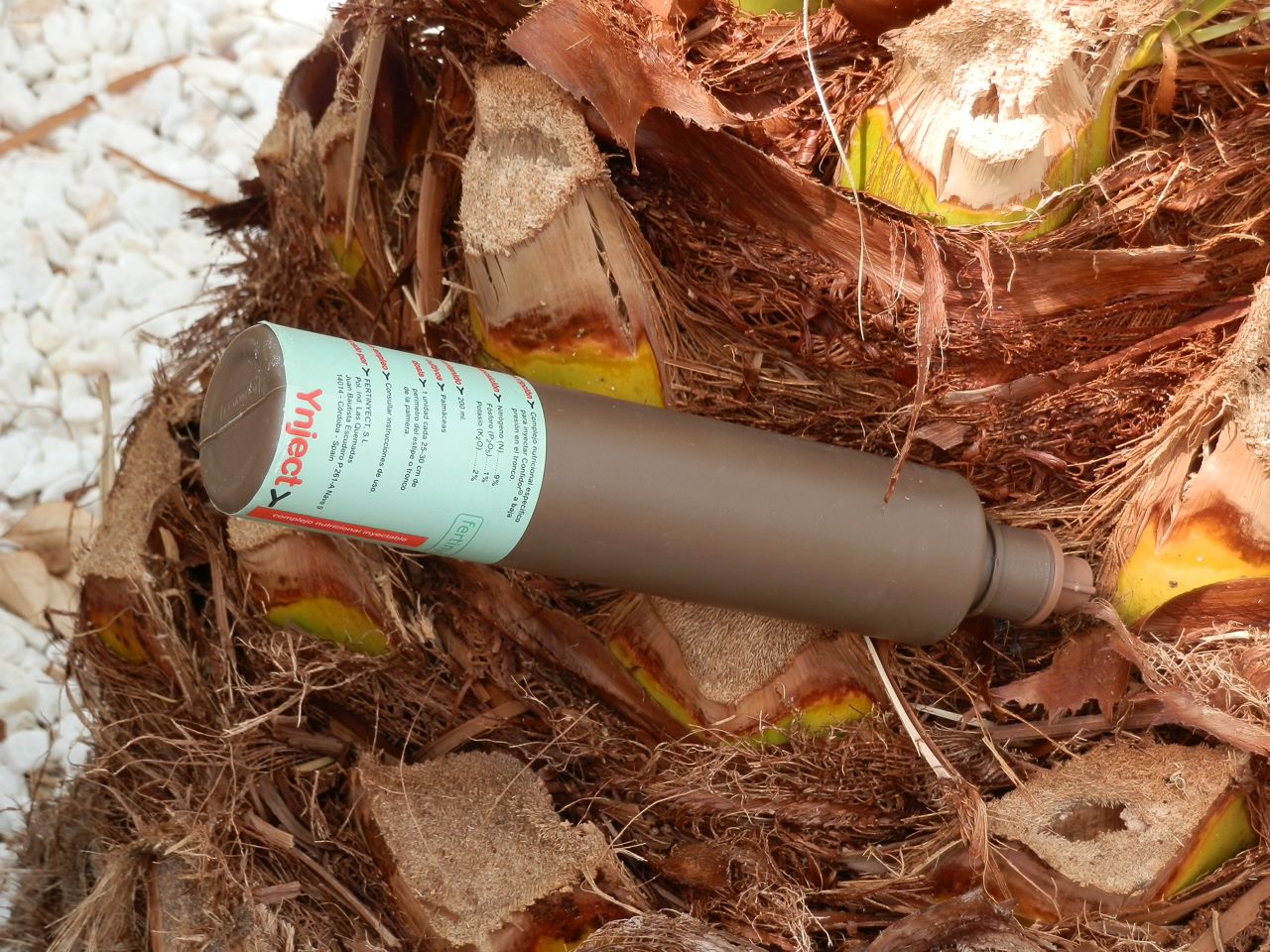
I, too have been spraying the Phoenix palm in our garden, which is next to the garden in which the affected palm was located. As the danger of attack by the beetle now seems more imminent, however, I have resorted to rather more drastic measures. These involvs the injection of a special chemical directly into the base of trunk of the palm. This procedure can be carried out in a DIY fashion, using equipment that can be purchased from Sospalm (and there's a link on their site to a video to show just how to do it), or the La Torre garden centre can come and place a similar system called Ynject in your palm together with a first dose of insecticide (good for three months) for just 25 euro. I chose the latter solution and here you see the insecticide bottle fitted to the injector, which has been inserted into a long hole, drilled into the base of the palm.
![]() |
| Ynject system fitted with insecticide tube |
The insecticide drains into the injector and so into the base over the course of three days, after which the tube can be removed, leaving the fitment of the injector inserted in the palm, practically invisible, but ready to be used again for the next tube in three months time. Apparently, this system is highly effective.
If you have one or more Phoenix-type palms (those with long fronds), then you should at least ensure that they are regularly sprayed with an insecticide that is recommended for use against the Picudo Rojo. For more security, the injection-type of application not only offers better protection, it also means that you need only repeat the treatment every three months.
As for Washingtonia-type palms (those with hand-palm-like leaf fronds), these are far less susceptible to attack by the Picudo Rojo. Note, however, that this does not mean that they are immune to attack, so preventative spraying with a suitable insecticide is still recommended.
![]() |
| Washingtonia type palm |
For more information on the Picudo Rojo (Red Palm Weevil), see
Thursday, 26 July 2012
The Dama de Guardamar
To celebrate the 25th anniversary of her discovery, the Dama de Guardamar (also known as the Dama de Cabezo Lucero) has returned to Guardamar from her usual residence in the Archaeological Museum of Alicante (MARQ). She will remain displayed here until 6 October 2012.
The Dama de Guardamar is a sculptured bust of an Iberian lady that was discovered on 22 September 1987 in the archeological site of Cabezo Lucero, which is not very far at all from El Raso.
Unlike her similar counterpart, the Dama de Elche, which was discovered intact, only pieces of the Dama de Guardamar were found, and these showed signs of having been deliberately broken by hammering, as well as scorch marks. Some pieces, however, were quite large, including one of the wheel-like ornaments worn on each side of the head, part of the face, neck and head-dress. In any case, sufficient pieces were found to identify the piece as a bust and to enable its full reconstruction. This took place in the Archaeological Museum of Alicante between October 1987 and June 1988.
The Lady of Guardamar probably dates form between 400 and 370 BC.
The exhibition that has been organised around the Dama de Guardamar can be visited for free in the Casa de Cultura. It is tastefully done, with explanatory notes in Castilian, Valenciano, and English. Sadly, instead of being shown as the Lady of Guardamar, the Dama is indicated as being the Dame of Guardamar, which seems to place her more in the realm of pantomime than patrimony.
Sunday, 5 February 2012
Earthquakes
We were rudely awoken at a quarter to six this morning (a quarter to six, mind you: that's 05:45 and far too early for any living organism to be awoken) by a strange rumbling noise and a brief but very noticeable shaking. Responsible for this unwelcome phenomenon was a small earthquake of magnitude 3.1, whose epicentre was located some 15 kilometres off the coast of Torrevieja, at a depth of about 11 kilometres.
Numerous earthquakes have occurred in the area during the past twelve months, but few have been of sufficient strength to have been felt. Also, they have usually taken place during the daytime, so that their effects are noticed less. The last largish tremor was on 23 March, 2011, but it took place close to midday and, even though it was of the same strength as today's, many people didn't even notice it.
No damage or injury has been reported as a result of today's tremor.
We live in a seismically active area, so tremors and quakes are not at all unusual. Few, however, are as strong as the 1829 earthquake, known as the Torrevieja Quake. This occurred on 21 March, 1829, when numerous towns in the Alicante province were seriously affected, with the most damage being in Almoradí.
Between 1820 and 1830 an unusual amount of seismic activity was registered in the province, especially along the three fault lines of the Bajo Segura (lower Segura): Benijófar, Guardamar del Segura, and Torrevieja.
Between 13 September, 1828 and 21 March, 1829, it is estimated that more than 200 quakes took place. Finally, at a quarter past six in the evening of 21 March, a major quake with a magnitude of 6.6 on the Richter scale, with its epicentre between Benijófar and Torrevieja, caused 389 deaths and 209 injuries, and destroyed more than two thousand homes, with many others badly damaged. The bridges across the river Segura in Almoradí, Benejúzar, Dolores, and Guardamar were all destroyed. Half of the fatalities were in Almoradí, where the roads were narrower than elsewhere and the buildings higher.
In our own Guardamar, 380 houses were completely destroyed, 140 received considerable damage, and 115 suffered fire damage (fortunately, only four people lost their lives and 20 were injured). The medieval town was completely destroyed, so that a new town had to be designed and built. This was done based on a neoclassical plan, having long straight roads with perpendicular intersections and three squares (two small, one large) arranged symmetrically. The new houses were built low and with large yards, in order to minimise the effects of future earthquakes. Stones from the old town were used to build the new. The photo below, dating from 1930, shows the layout of the rebuilt town, with the castle and old town visible in the top right.
Numerous earthquakes have occurred in the area during the past twelve months, but few have been of sufficient strength to have been felt. Also, they have usually taken place during the daytime, so that their effects are noticed less. The last largish tremor was on 23 March, 2011, but it took place close to midday and, even though it was of the same strength as today's, many people didn't even notice it.
No damage or injury has been reported as a result of today's tremor.
We live in a seismically active area, so tremors and quakes are not at all unusual. Few, however, are as strong as the 1829 earthquake, known as the Torrevieja Quake. This occurred on 21 March, 1829, when numerous towns in the Alicante province were seriously affected, with the most damage being in Almoradí.
Between 1820 and 1830 an unusual amount of seismic activity was registered in the province, especially along the three fault lines of the Bajo Segura (lower Segura): Benijófar, Guardamar del Segura, and Torrevieja.
Between 13 September, 1828 and 21 March, 1829, it is estimated that more than 200 quakes took place. Finally, at a quarter past six in the evening of 21 March, a major quake with a magnitude of 6.6 on the Richter scale, with its epicentre between Benijófar and Torrevieja, caused 389 deaths and 209 injuries, and destroyed more than two thousand homes, with many others badly damaged. The bridges across the river Segura in Almoradí, Benejúzar, Dolores, and Guardamar were all destroyed. Half of the fatalities were in Almoradí, where the roads were narrower than elsewhere and the buildings higher.
In our own Guardamar, 380 houses were completely destroyed, 140 received considerable damage, and 115 suffered fire damage (fortunately, only four people lost their lives and 20 were injured). The medieval town was completely destroyed, so that a new town had to be designed and built. This was done based on a neoclassical plan, having long straight roads with perpendicular intersections and three squares (two small, one large) arranged symmetrically. The new houses were built low and with large yards, in order to minimise the effects of future earthquakes. Stones from the old town were used to build the new. The photo below, dating from 1930, shows the layout of the rebuilt town, with the castle and old town visible in the top right.
(Photo from the book, Guardamar del Segura. Arqueología y Museo available from the Casa de Cultura, Guardamar)
Thursday, 5 January 2012
Roscón de Reyes
Since before Christmas you have probably noticed variously sized, though usually quite large, circular pastries in patisseries and the corresponding sections of supermarkets. These are the so-called roscón de Reyes, which is a traditional cake, baked for consumption on the afternoon of 6 January, the Day of the Three Kings.
Dough is formed into a circle and decorated with pieces of crystallised fruits of various colours, and is also often sliced and filled with cream or confectioner's custard. In addition, a bean and a porcelain figure are hidden in the cake.
As with almost all traditions related to Christmas, the origin of the roscón dates back to earlier pagan traditions and probably to the Saturnalia, the ancient Roman festival in honour of the deity Saturn. At that time, circular cakes made with figs, dates and honey were distributed equally between both plebeians and slaves. Reports indicate that as early as the third century a bean was hidden in the cake and that the person who received the piece containing the bean was named the King of Kings for a predetermined period of time.
It is only since the twentieth century that the cake has been prepared with a filling of cream, or confectioner's custard, or even cabello de ángel (a very sweet pumpkin preserve). A porcelain figurine, usually representing some biblical character, is hidden in the cake, and the tradition of hiding a bean in the cake also remains, though its finder is less fortunate than in earlier times: now they have to pay for the cake, whereas the finder of the figurine is allowed to wear the crown (usually a paper crown is sold with the cake).
Dough is formed into a circle and decorated with pieces of crystallised fruits of various colours, and is also often sliced and filled with cream or confectioner's custard. In addition, a bean and a porcelain figure are hidden in the cake.
As with almost all traditions related to Christmas, the origin of the roscón dates back to earlier pagan traditions and probably to the Saturnalia, the ancient Roman festival in honour of the deity Saturn. At that time, circular cakes made with figs, dates and honey were distributed equally between both plebeians and slaves. Reports indicate that as early as the third century a bean was hidden in the cake and that the person who received the piece containing the bean was named the King of Kings for a predetermined period of time.
It is only since the twentieth century that the cake has been prepared with a filling of cream, or confectioner's custard, or even cabello de ángel (a very sweet pumpkin preserve). A porcelain figurine, usually representing some biblical character, is hidden in the cake, and the tradition of hiding a bean in the cake also remains, though its finder is less fortunate than in earlier times: now they have to pay for the cake, whereas the finder of the figurine is allowed to wear the crown (usually a paper crown is sold with the cake).
Friday, 16 December 2011
Spanish Christmas Carols
There is not really a tradition in Spain for the type of Christmas carols that we know in more northerly parts of Europe. Some of those carols are known here and have their own Spanish versions, such as Venid Fieles (Adeste Fiedeles), Al Mundo Paz (Joy To The World) and Noche de Paz (Silent Night), but the real Christmas singing tradition here is based on a large group of songs called Villancicos.
The villancico was a popular form of poetry and singing in Spain, Portugal, and their colonies, for several centuries, starting in the second half of the 15th and continuing into the 18th. The style declined in popularity in more recent times and the term "villancico" gradually came to represent little more than a Christmas carol.
Despite, this degeneration, the medieval musical influence can still be gleaned in the villancicos that remain popular around the Christmas period. This is aided by the often medieval flavour of the music and its instrumentation, which still often consists of little more than a simple drum, a zambomba (a friction drum, or, in Dutch, a rommelpot), and some tambourines (panderetas in Spanish). In the Comunidad Valenciana, a dulzaina might also be used and in Andalucía, the villancico has become particularly popular performed in flamenco style, accompanied by guitars, castanets, hand-clpping and the cajón.
Villancicos are most often sung by groups of children (who, strangely enough, seem to have little musical ability) and this adds to the naivety of the whole. A glorious exception to this rule is provided by the flamenco performers of villancicos, who transform the simple songs into superbly exciting numbers: look out for a group called Raya Real in this respect.
So why not scrap the traditional carols this year and instead go for a more Spanish form of Christmas entertainment? You can find plenty of sites online where you can listen to villancicos, performed both well and badly, and lots of CDs are available in the shops, too, though these are of equally diverse quality.
Navidad Digital is a good place to start. Not only does the site offer many, many villancicos, it also allows you to hear carols in French, German, Italian, Latin and English. (In addition, you will find information about Belenes, recipes for traditional end-of-year fare, and hundreds of photos.)
And here is a short list of some of the more popular and traditional villancicos:
- La Marimorena
- Campana Sobre Campana
- El Burrito Dabanero
- Ya Viene La Vieja
- Los Peces En El Rio
- Arre Borriquito (Arre Burro Arre)
- Alegría Alegría
- Fum Fum Fum
- Rin, Rin
- El Chiquirritín
¡Felices fiestas!
Friday, 11 November 2011
Museo de Belenes
If you have an hour or so to spare in Alicante, a very pleasant way of passing the time is to visit the Museo de Belenes (Nativity Scenes museum).
You don't have to be Christian to enjoy the displays of modelling that are exhibited in this small, but well looked after museum. I'm an atheist, but have been fascinated by the Spanish tradition of Belenes since I first discovered it some ten years ago and can only admire the work and dedication that goes into setting up these delightful models.
You can find Belenes all over Spain during the weeks leading up to the celebrations of the winter solstice (used by Christians to celebrate the birth of Jesus Christ) and on to Epiphany. They range in size from small scenes that people set up in their homes to very large scenes, sometimes displayed by a village or town, either outside, or, as in Guardamar, in a special room. Sometimes the scenes are extremely large, covering many square metres, often set up by local enthusiasts. San Javier, where the Murcia airport is located, claims to have the largest open-air Belen of Spain, covering 520 square metres and incorporating more than 1200 model figures with many moving elements. Another large one not too far from Guardamar is to be found in Casillas, a suburb of Murcia. This Belén is under cover and is particularly well known for its many moving parts.
Almost all Belenes have a secret: somewhere, hidden in the scene or scenes depicted, is a man crouching down, with his trousers around his ankles, doing his business. He is known as El Caganer (the crapper) and is said to be fertilizing the soil of the Belén, so that it will flourish again the following year. Probably originating in Catalonia, the caganer has become a popular element in Belenes and a small industry has grown around this single figure, selling not only the traditional form, but others, too, often depicting well-known personalities, including royalty and politicians, such as Barak Obama and Angela Merkel, to name but two.
I have to admit that I did not notice a Caganer in the museum, which was something of a disappointment, but otherwise the museum is a jewel, with many typically Spanish displays, as well as numerous nativity scenes from other parts of the world. The models are made of all sorts of material, ranging from clay, to wood, to ceramics, as well as less likely materials.
Entry to the museum is free. It is open from Tuesday to Friday, from 10:00 until 14:00 and from 17:00 until 20:00. You can find more information and a map of the location of the museum here.
I have made a small Picasa album, showing the inside of the museum.
You don't have to be Christian to enjoy the displays of modelling that are exhibited in this small, but well looked after museum. I'm an atheist, but have been fascinated by the Spanish tradition of Belenes since I first discovered it some ten years ago and can only admire the work and dedication that goes into setting up these delightful models.
You can find Belenes all over Spain during the weeks leading up to the celebrations of the winter solstice (used by Christians to celebrate the birth of Jesus Christ) and on to Epiphany. They range in size from small scenes that people set up in their homes to very large scenes, sometimes displayed by a village or town, either outside, or, as in Guardamar, in a special room. Sometimes the scenes are extremely large, covering many square metres, often set up by local enthusiasts. San Javier, where the Murcia airport is located, claims to have the largest open-air Belen of Spain, covering 520 square metres and incorporating more than 1200 model figures with many moving elements. Another large one not too far from Guardamar is to be found in Casillas, a suburb of Murcia. This Belén is under cover and is particularly well known for its many moving parts.
Almost all Belenes have a secret: somewhere, hidden in the scene or scenes depicted, is a man crouching down, with his trousers around his ankles, doing his business. He is known as El Caganer (the crapper) and is said to be fertilizing the soil of the Belén, so that it will flourish again the following year. Probably originating in Catalonia, the caganer has become a popular element in Belenes and a small industry has grown around this single figure, selling not only the traditional form, but others, too, often depicting well-known personalities, including royalty and politicians, such as Barak Obama and Angela Merkel, to name but two.
I have to admit that I did not notice a Caganer in the museum, which was something of a disappointment, but otherwise the museum is a jewel, with many typically Spanish displays, as well as numerous nativity scenes from other parts of the world. The models are made of all sorts of material, ranging from clay, to wood, to ceramics, as well as less likely materials.
Entry to the museum is free. It is open from Tuesday to Friday, from 10:00 until 14:00 and from 17:00 until 20:00. You can find more information and a map of the location of the museum here.
I have made a small Picasa album, showing the inside of the museum.
Monday, 7 November 2011
Stray Cats
I dislike cats at the best of times. Stray cats are even worse. They are a plague on society and, in my opinion, should be eliminated.
They should certainly not be fed by silly people who look upon them as poor, helpless creatures (and usually "God's creatures" at that). They are wild animals that carry diseases, worms, and other unpleasantness. The argument that they keep down vermin, such as mice and rats, is simply laughable: a cat has very little chance against a rat and if a stray cat knows it can get its food from that woman down the road, it is not going to bother to go out hunting. Rats and Mice? What about the lizards and birds that these obnoxious pests eat? The cats destroy these beneficial creatures in huge numbers (or they would, if they were not fed so much by people who should know better).
The photo shows the result of the latest stray cat damage in our garden. Apart from leaving their smelly faeces and urine around the place, the cats seem to enjoy digging in newly planted soil. They are pests and need to be destroyed. I, at least, am able to replace the soil and, when necessary, even replant disturbed or completely uprooted plants. People who do not live here permanently are unable to take such actions to correct the damage caused by these four-legged pests. There, is, of course, little that can be done but hope as far as urine burns on plants are concerned.
I call on you all to please stop feeding the stray cats.
(Please note that this is a personal opinion)
They should certainly not be fed by silly people who look upon them as poor, helpless creatures (and usually "God's creatures" at that). They are wild animals that carry diseases, worms, and other unpleasantness. The argument that they keep down vermin, such as mice and rats, is simply laughable: a cat has very little chance against a rat and if a stray cat knows it can get its food from that woman down the road, it is not going to bother to go out hunting. Rats and Mice? What about the lizards and birds that these obnoxious pests eat? The cats destroy these beneficial creatures in huge numbers (or they would, if they were not fed so much by people who should know better).
The photo shows the result of the latest stray cat damage in our garden. Apart from leaving their smelly faeces and urine around the place, the cats seem to enjoy digging in newly planted soil. They are pests and need to be destroyed. I, at least, am able to replace the soil and, when necessary, even replant disturbed or completely uprooted plants. People who do not live here permanently are unable to take such actions to correct the damage caused by these four-legged pests. There, is, of course, little that can be done but hope as far as urine burns on plants are concerned.
I call on you all to please stop feeding the stray cats.
(Please note that this is a personal opinion)
David Neale
Subscribe to:
Posts (Atom)