Friday, 7 June 2013

A special visitor

Megascolia maculata flavifrons (female)
Elise and I are privileged to have a rather unusual visitor to our garden, namely a mammoth wasp, or a Megascolia maculata flavifrons (also known as Scolia flavifrons). I believe that this is the largest wasp in Europe.

And it really does live up to its "mammoth" name, for it is at least 5cm long. In fact, I have spotted two individuals, the larger one at 5cm or more and a smaller one that is perhaps 4.5cm long. Both of them are impressive creatures.

Both of them are also females. The body of the female mammoth wasp is black with large yellow markings. She has strong wings, tinged with amber, resembling the skin of an onion, showing crimson in the variegated light. Her legs are coarse, with a knotted appearance and are very hairy. She has a huge body and a powerful head, which is well protected by a hard skull. Her flight is quite low and is surprisingly quiet for such a large insect. The male mommoth wasp, which I have not yet seen, is less colourful and of finer frame.

The mammoth wasp does not attack humans (no European wasps do, except out of self-defence, so stop waving your arms about). Instead, it hunts out the larvae of the rhinoceros beetle (Oryctes nasicornis), which it paralyses with its sting in order to lay a single egg in the beetle's body. When it emerges, the larva of Megascolia then devours that of the Oryctes.

Size comparison with ordinary wasp (Vespula vulgaris)


And here's a little video (the quality is far better than the preview image).

You can see more unusual visitors to our garden here.

David Neale

Tuesday, 4 June 2013

Jai-Pe Services

A new service has just been inaugurated in the Euroterra Commercial Centre of El Raso. The business is called Jai-Pe Services and has been the subject of numerous rumours.

No, it is not a new venture started by the owners of the Indian restaurant next door to the premises.

No, it is not a Gamma supermarket outlet.

No, it is not a hairdresser.

No…

Well, you get the idea.

What it is, is rather difficult to describe in just a few words. First, a bit of history. Some time ago, before the urbanisation El Raso was built, a young couple in Guardamar decided to branch out on their own, offering cleaning services to local businesses and communities of owners. Pedro and Maribel decided to call their new company Jai-Pe, a strange-sounding name, perhaps, but all becomes clear when you learn that they had a single apple of their eye; the name of the little lad (for little he was at the time) was Jairo.

Got it? Jai (from Jairo) and Pe (from Pedro), forming the exotic-sounding Jai-Pe.

Well, the cleaning business in Guardamar flourished and Jai-Pe extended its services to include individual properties and all aspects of cleaning: windows, tiles, terraces, garages… they'll come along and do an excellent job, as several users of their services on El Raso and within our own community will testify.

Maribel, knowing a good thing when she sees it (well, she married Pedro, didn't she?) recently decided that there might be a gap in the market and thought El Raso would be a good place to test her theory. Pedro saw something in it, too, so the couple leased one of the units in the commercial centre and have now set it up as a sort of information and contact centre.

Not only can you go to the establishment to buy cleaning products of all sorts, but Jai-Pe Services also offers a collaboration service, so that, should you need to find, say, a bricklayer, or a plumber, or a gardener, or a locksmith, or a carpenter, or a metalworker, or anything else to do with the maintenance of your property, you need only visit Jai-Pe Services and their staff will help you find just who you need. They'll even find you translators and interpreters if you wish.

Of course, you can also arrange to have your property cleaned, either on a regular basis, or just when you wish, and Jai-Pe Services will also act as key-holder for you when you are not here, but still need your property to be accessible.

Jairo (the apple of his parents' eye, remember?) is now a young man, recently graduated from higher education, and he has taken on the responsibility of running the new Jai-Pe Services office in El Raso. He has a small staff to help him.

You can find out more about Jai-Pe Services at their website, which will soon also be available in English.


David Neale


Wednesday, 10 October 2012

Our trip to the Alcalá del Júcar Cave


Houses built into the mountainside, and the castle
On Sunday 30th September last, John and I with a few friends went on a coach outing to see the Alcalá del Júcar Cave.

On our way we stopped for coffee and a walk around  the charming historical town of Almansa.

We then drove on to the fascinating cave village of Alcalá del Júcar. This is a beautiful little village, standing on the banks of the river Jucar and featuring cave houses, a castle, and a quaint market.

Photo courtesy of Juan Manuel Monleón Antón (WikiPedia)

The trip included a meal at a very Spanish restaurant on the top of the mountain. The restaurant was owned by the Mayor who also seemed to own most of the rest of the village! The food was excellent and included wine and water.  The scenery was stunning as you looked down into the village below with the homes going into the mountain.

Looking down into village from mountain-top restaurant

The river Júcar runs through this village and has a small beach, which is man-made. The  market has a few stalls for you to browse around. There are various places for you to have a meal or a drink. We walked up a number of steps to a bar which was built into the mountain.

The coach left us about half way down the mountain, from where we then had to walk about a quarter of a mile continuing down into the village, until we eventually arrived at what looked like the front of a house. We had to pay 3 euro entrance fee and went down over one hundred steps into a very narrow passage. There were gaps every so often in the walls which had pieces of old farming equipment and old items of furniture on display. At the end of this walk we arrived at an area where there was a bar for you to obtain a drink, using the ticket given to you when you paid your 3 euro entry. This area had tables and chairs for you to sit and enjoy the views from the various windows and a large area which we believe was used for discos.

We then walked back to where the coach had originally left us in the village and continued our journey home.

The trip took us about two and half hours to get there, so it is quite a way to visit. But if you have the time and enjoy seeing different and unusual places then it is well worth a visit.

This is a superb day out with lots of places to wander around and see all the different types of buildings. The cost is about 28 euro each with the company David’s Coachtrips.

We certainly enjoyed the day and hope you will too.
Wendy & John Laker

Here are some more photos from John and Wendy:


Spot the ostrich

For more information about Alcalá del Júcar, visit this WikiPedia page.

Saturday, 22 September 2012

Lady of Elche (La Dama de Elche)


In Belgium we say that there is no such thing as a stupid question, only a stupid answer.

When I was at school (yes, I know, a very long time ago…), I had a very wise geography master who took that train of thought a little further: he told us never to be afraid to ask questions and that if one person did not know something, then at least five other people in the class would want to ask the same question. (He was the same master who would not allow us to take notes during his classes, other than on the concrete blocks of our minds, as he put it. He was quite correct in both matters: note-taking is counter-productive and if you do not know about something, there are plenty of others in the same position.)

I was talking to one of our community members recently and was surprised that she had never heard of La Dama de Elche (the Lady of Elche). So, asking the question, "Who is the Dama de Elche?" and following the principles above, we see that

a. it is not a stupid question;

and

b. there must be quite a few other people in our community who know little or nothing about La Dama de Elche.

So, who is she?

Well "she" is really an "it," being a stone bust that was discovered by pure chance in 1897 on a small rise near Elche known as Alcudia (from the Arab word meaning a mound, or small hill). If you drive to Elche using the road though Benijófar, you pass by Alcudia a couple of kilometres before reaching Elche.

It is believed that the Dama de Elche is an Iberian sculpture, dating from the 4th century BC. Who she is, or what she represents is not known with any degree of certainty. Some suggest she represents the Carthaginian goddess Tanit, others that she is, in fact, an urn for storing the ashes of a cremation (a large aperture at the back might indicate this), and there have even been claims that she is a forgery, though these have been adequately dismissed.

What is known, is that she was once painted with lifelike colours and some remnants of these colours can be seen even with the naked eye.

La Dama de Elche was taken to France shortly after her discovery, but was returned to Spain in 1941. Since then she has been located in Madrid. However, between May and November 2006 the Dama was placed on temporary display in Elche and many people took the opportunity to admire her, often forming long queues to be able to do so.

She is a truly beautiful piece of sculpture, far more beautiful than any of the photos of her, and infinitely more so that the multiplicity of reproductions that exist in a whole range of sizes. Several "damas" have been found in Spain: the Dama de Baza, the Gran Dama Oferente, and our own Dama de Guardamar, of course, but none match the beauty of the Dama de Elche.

Here are some photos that I took when the Dama was on display in Elche in the Museo Arqueológico y de Historia (close to the park and well worth a visit). You usually only see her from the front, so I have included one from the back, too, showing the aperture referred to above. The quality of the photos is not wonderful, I'm afraid: the bust was enclosed in a thick glass case in a relatively dark room and I did not have a suitable tripod.


The area where the Dama was found has since become a major archaeological site and offers an interesting place to visit very close by, being no mire than a twenty-minute drive. Go through Benijófar and follow the signs to Elche. Shortly before reaching Elche, on the road of the many roundabouts) you will see signs to the right for Alcudia (if you miss the first lot, don't panic, there's another turning a bit further on). You can find more information, including videos and other documentation here.


Wednesday, 19 September 2012

Waste of time!


At the end of the recent AGM, I took the opportunity to once again remind those present about the existence of this very blog. I heard at least one of those present muttering that it was, "A waste of time."

Well, that person might well be right. I might indeed be wasting my time writing these little articles every now and then and publishing them in this blog. I probably wasted my time a few years ago, when I worked on our brief, but now defunct, community newsletter.

However, I think that I was only wasting my own time then and I think that also applies now. Well, okay, there were a couple of minutes at the end of the AGM when I might have wasted everyone's time and I apologise for that.

Actually, I don't think the newsletter was a waste of time. Hardly anyone bothered to contribute anything to be published in it, but when I announced the final issue I did receive a few emails from people who thought it was a shame that there were to be no more issues, so it seems to have pleased some, and that is never a waste of time.

In the same way, I don't think this blog is a waste of time. It might encourage some members of the community to exercise their writing skills; it might provide interesting reading now and then; it might help promote at least a hint of community spirit, something that seems to be sadly lacking. And if it doesn't work, then at least I've tried.

That's what I think, anyway. At least one of you thinks otherwise, clearly. But what about all the rest? What do you think? Is this blog a waste of time?

Let me know through the usual channels (community email address or as a blog entry comment).


Thursday, 13 September 2012

2012 AGM

The Rasomar VI Community AGM was held today, 13 September, 2012, and here's a photo to prove it.

19 people, representing ten houses, attended (there's one behind the camera, remember) and numerous others were represented by proxy.

You will undoubtedly soon be receiving details of who was there, what was discussed, and so on, in the minutes that will be sent out as soon as they are ready.

The meeting lasted almost two hours.

Monday, 10 September 2012

Picudo Rojo, the Red Palm Weevil, strikes!

A year ago, I wrote an entry about the Red Palm Weevil, the Picudo Rojo. Things have certainly not improved since then. Indeed, the Picudo Rojo has created its first victim (that I am aware of) in our community.

 A Phoenix palm in Calle San Bruno suddenly showed signs of distress and investigation proved that it had been attacked by the Picudo Rojo. Its leaves had fallen more open than normal and some of the central leaves could be easily pulled out of the stem, because the larvae of the beetle had eaten away the connecting tissue.

Affected Phoenix palm


Base of leaf stem, eaten by larvae

The palm in question had been regularly sprayed with insecticide, but this was clearly insufficiently effective to prevent the devastating attack and the loss of the palm.

The palm has had to be removed and destroyed. When it was cut, several beetles were found in the base, as well as many larvae, some very small, others very large. Here are some of these attractive individuals…

Larvae of Picudo Rojo

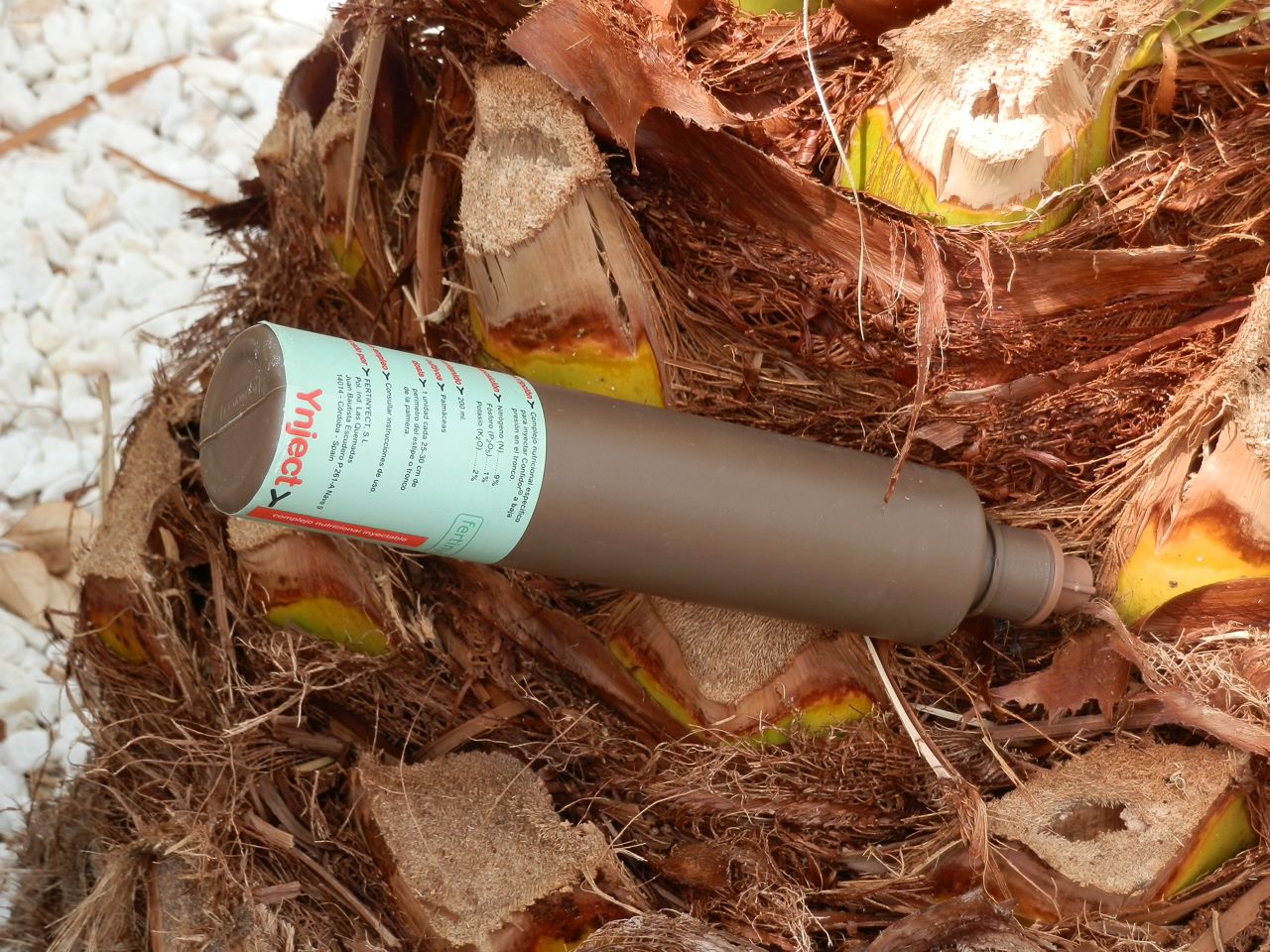
I, too have been spraying the Phoenix palm in our garden, which is next to the garden in which the affected palm was located. As the danger of attack by the beetle now seems more imminent, however, I have resorted to rather more drastic measures. These involvs the injection of a special chemical directly into the base of trunk of the palm. This procedure can be carried out in a DIY fashion, using equipment that can be purchased from Sospalm (and there's a link on their site to a video to show just how to do it), or the La Torre garden centre can come and place a similar system called Ynject in your palm together with a first dose of insecticide (good for three months) for just 25 euro. I chose the latter solution and here you see the insecticide bottle fitted to the injector, which has been inserted into a long hole, drilled into the base of the palm.

Ynject system fitted with insecticide tube

The insecticide drains into the injector and so into the base over the course of three days, after which the tube can be removed, leaving the fitment of the injector inserted in the palm, practically invisible, but ready to be used again for the next tube in three months time. Apparently, this system is highly effective.

If you have one or more Phoenix-type palms (those with long fronds), then you should at least ensure that they are regularly sprayed with an insecticide that is recommended for use against the Picudo Rojo. For more security, the injection-type of application not only offers better protection, it also means that you need only repeat the treatment every three months.

As for Washingtonia-type palms (those with hand-palm-like leaf fronds), these are far less susceptible to  attack by the Picudo Rojo. Note, however, that this does not mean that they are immune to attack, so preventative spraying with a suitable insecticide is still recommended.

Washingtonia type palm

For more information on the Picudo Rojo (Red Palm Weevil), see